


On this page
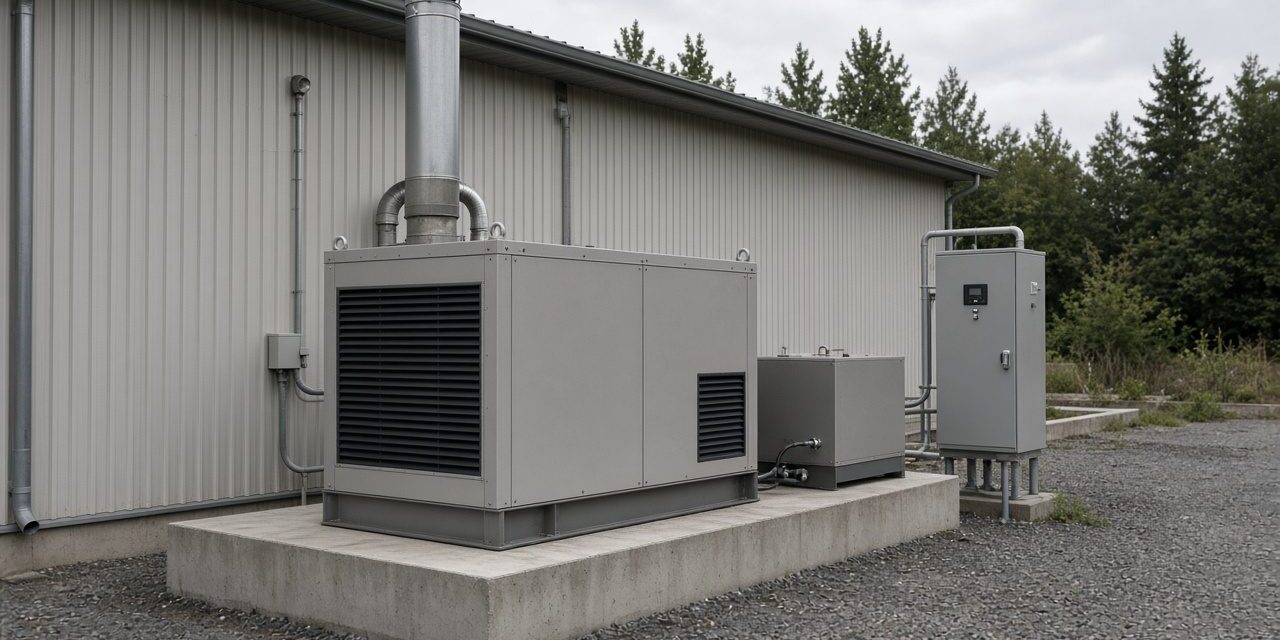
A generator set makes its own electricity from an engine and an alternator when the mains cannot. On most sites it is the long-duration half of the backup plan: the UPS covers the seconds, and the generator covers the hours. This sheet explains standby and prime duty, what is included from 10 kVA to 2,500 kVA, and the sequence that has to work on the day of a real outage.
What to settle before a set is chosen
- Standby or prime. Standby runs during mains failures. Prime is the normal source, with the mains as backup or with no mains at all. The same engine is not rated the same way for both.
- The load that must move to the set, including motor starting, not only the steady kilowatts on a nameplate.
- How long it must run. That sizes the fuel store and the day tank, not the alternator.
- Where it can stand. Noise, exhaust, access for service, and a cable route to the transfer panel decide the canopy and the position.
What you are actually buying
| Part | What it does |
|---|---|
| Engine | Diesel or gas. Turns fuel into shaft power. The maintenance plan is mostly about this. |
| Alternator | Turns shaft power into electricity at the site voltage and frequency. |
| Controller | Starts the set, watches oil, temperature, and frequency, and shuts it down on a fault. |
| Canopy | Open set, a silent canopy, or a container. This is weather and noise, not electrical capacity. |
| ATS panel | The automatic transfer switch. It moves the load from mains to generator and back, without someone throwing a handle. |
| Fuel system | Day tank plus bulk storage. A set with no fuel plan is a set that stops. |
PSS supplies diesel and gas sets across 10 kVA to 2,500 kVA, with the transfer panel and the fuel system as part of the same job. Where one set is not enough, or where one set must be serviceable while the site stays supplied, sets are synchronized to share the load.
The start sequence
- The mains fails. The ATS waits a few seconds so a one-second blink does not start the engine.
- The controller cranks the engine. It comes up to speed and voltage.
- The ATS transfers the selected load onto the generator.
- A UPS on the critical circuits has been carrying those circuits the whole time. The generator now feeds the UPS input, and the batteries recover.
- When the mains returns and stays healthy, the ATS transfers back and the set runs a cool-down, then stops.
That sequence is the thing to test, on a planned day, with the real load or a planned part of it. A set that has never been transferred will find its fault during an outage.
Practical sizing and testing notes
- Calculate the step load. A generator may carry the running load and still fail when a pump, chiller, or compressor starts. Starting current, motor-start method, and load sequence belong in the calculation.
- Coordinate protections. Generator breaker settings, ATS ratings, downstream breakers, and earth-fault protection must work together. A set that trips first can leave the whole essential board dark.
- Test under load. Exercise the automatic start, warm-up, transfer, return-to-mains, cool-down, emergency stop, alarms, and fuel indication. A no-load start proves very little.
The handover pack should contain the load schedule, fuel autonomy calculation, cable and earthing details, ATS cause-and-effect, controller settings, test results, and service intervals. Record the battery voltage and coolant condition as well as the engine hours.
Common problems and how to fix them
The engine does not start when the mains fails
- The starter battery is flat. It is a separate battery from the UPS bank, and it needs its own charger checked.
- The fuel is old, empty, or the day tank was isolated.
- The controller is in manual or off, left that way after the last service.
It starts, then trips as soon as the load comes on
The transferred load, especially motors starting together, is above what the set can accept in one step. Stage the loads, or choose a set rated for that step. An undersized alternator shows up as a voltage collapse, not as a slow engine.
The set runs, but the building is still dark
The ATS did not transfer, or only part of the distribution is on the generator side. Essential and non-essential boards have to be split on purpose. A generator that is asked to pick up everything, including the chillers, often protects itself by tripping.
Frequently asked questions
Why do I still need a UPS if I have a generator?
The generator needs time to start, and its voltage moves while it accepts load. The UPS covers that gap for the circuits that cannot reboot. The generator then keeps those circuits up for as long as the fuel lasts.
What is the difference between standby and prime?
Standby is for mains failures and is not the everyday source. Prime is a continuous source. Tell the supplier which one you mean; the rating and the service intervals follow from it.
How often should a standby set be run?
On a schedule, under load, long enough to reach operating temperature, and with a full transfer test at planned intervals. A monthly no-load tick-over does not prove the ATS or the alternator.
Talk to PSS about generators
PSS supplies and maintains standby and prime generators from 10 kVA to 2,500 kVA, with the transfer panel and fuel system. Contact the PSS team to book a first site survey.
