


On this page
A CCTV system is cameras, a recorder, and a way to look at the pictures later. The design question is which risks the site needs to see, not how many cameras fit the budget. This sheet separates the camera types and the two recorders, and lists the choices that decide whether a recording is actually usable.
What to walk before placing a camera
- The risks. A gate, a cash point, a yard, a server-room door, and a production line are different pictures. Each one needs its own view.
- Light. Noon, dusk, and the hours the site is actually empty. A camera that is fine at midday can be blind at the time you need it.
- Identification or awareness. A face or a plate number needs a tighter view than “someone walked through the yard”.
- How long recordings are kept, and who must be able to open them from outside the site.
Cameras and recorders
| Analog / HD over coax | IP | |
|---|---|---|
| Cable | Coaxial cable back to the recorder | Network cable, often with power over the same cable (PoE) |
| Recorder | A DVR | An NVR, or recording software on a server |
| Fits | A small site, or a replacement that keeps existing coax | New systems, long runs, and anything that will grow |
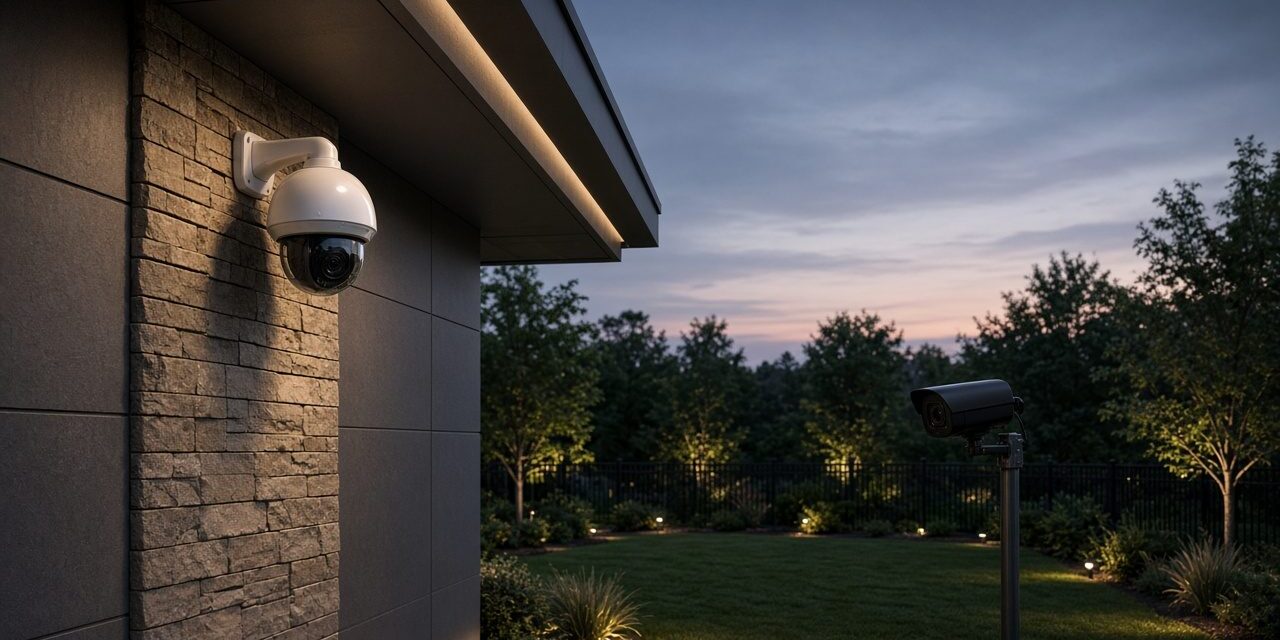
| Shapes | Dome for ceilings and vandal-prone spots, bullet for a directed view, PTZ where one camera must patrol, thermal where smoke, glare, or total darkness defeats a normal sensor | |
HD over coax (often called HD-TVI and similar formats) is the middle step: better pictures on the old cable, still into a DVR. A new site with more than a handful of cameras is usually an IP system, because the same network can carry cameras, access readers, and the office, if it was designed for that. PSS plans coverage around the risks, then installs, commissions, and maintains the system.
Night, retention, and remote view
Infrared or a low-light sensor is what makes a night picture. It still needs a view that is not staring into a lamp. Retention is a storage sum: cameras, quality, and days. Raising quality or adding cameras without adding disks shortens the history you can search. Remote viewing belongs on a recorder that is online on purpose, with its own password, not on a camera left at a factory default.
Practical CCTV design and handover notes
- Write the operational target. Detection, recognition, or identification needs different pixel density, lens choice, mounting height, and scene width. “One camera per room” is not a design target.
- Calculate storage and bandwidth. Camera count, resolution, frame rate, codec, scene movement, recording mode, and retention all change the disk and uplink requirement.
- Protect the recordings. Use unique credentials, time synchronisation, a documented user-permission model, and UPS-backed recorder and network equipment.
Commissioning should check focus in day and night mode, date and time, field of view, IR reflection, playback and export, camera loss alarms, disk health, remote access, and the actual retention achieved. Keep a camera schedule with location, IP address, switch port, recording profile, and purpose.
Common problems and how to fix them
The picture is there, but you cannot tell who it is
The camera is too wide, too high, or looking into the light. Move it or add a second camera for the identification view. More megapixels on the same wide shot often do not fix this.
Last night is missing
- The disk is full because retention was never calculated.
- The camera dropped off the network and the recorder stored nothing for that channel.
- Recording was set to motion only, and the motion area does not cover the door.
Remote view works on site and fails from home
Local viewing uses the LAN. Remote viewing needs the recorder reachable from outside, and enough upload speed for the streams you open. Start with one or two sub-streams, not every camera at full quality.
Frequently asked questions
What is the difference between a DVR and an NVR?
A DVR records cameras that arrive on coaxial cable. An NVR records IP cameras that arrive over the network. The screen looks similar. The cabling and the growth path do not.
Do IP cameras need a separate network?
They need a designed one: enough ports with power, a path that does not share a saturated office switch, and addresses that do not change. They do not need to be a mystery second LAN with no documentation.
How many days of recording should I keep?
Long enough to notice an incident and still find it. A weekend site and a staffed control room are not the same number of days. Decide the days first, then the disks, not the other way around.
Talk to PSS about cameras
PSS designs, installs, and maintains CCTV systems, from a few cameras to a large IP network. Contact the PSS team to book a first site survey.