


On this page
A UPS (uninterruptible power supply) sits between the mains and the equipment that cannot drop out, even for a moment. When the supply fails, sags, or spikes, the UPS keeps that load running from its batteries and hands it a clean waveform. This sheet covers the three common types, what the battery bank is actually for, and how a UPS sits next to a generator.
What to decide before anyone sizes a unit
- Which loads must stay up. A server, a recorder, an access controller, and a PLC are usual candidates. General lighting and air conditioning usually are not.
- How long they must stay up. A few minutes is enough for a clean shutdown or until a generator takes the load. A longer ride-through needs a larger battery bank, not a larger UPS alone.
- Single-phase or three-phase. Match the supply the load is already fed from.
- Whether a short break is acceptable. Some equipment reboots on a transfer of a few milliseconds. That choice decides the topology.
The three types
| Offline (standby) | Line-interactive | Online double-conversion | |
|---|---|---|---|
| Normal path | Mains feeds the load directly | Mains feeds the load, with a buck/boost tap | Mains is rectified, then inverted; the load always sees the inverter |
| Break on failure | A few milliseconds while the inverter starts | A short transfer | None. The inverter is already running |
| Cleans the power | Only while on battery | Corrects modest voltage swings | All the time |
| Usual place | A single workstation | A small cabinet of network gear | Servers, control panels, recorders, and any load that must not flicker |
PSS specifies online double-conversion for critical loads, in single-phase and three-phase, because the equipment never sees the raw mains. Offline and line-interactive units still have a place where a brief transfer is harmless and the load is small.
What the battery bank decides
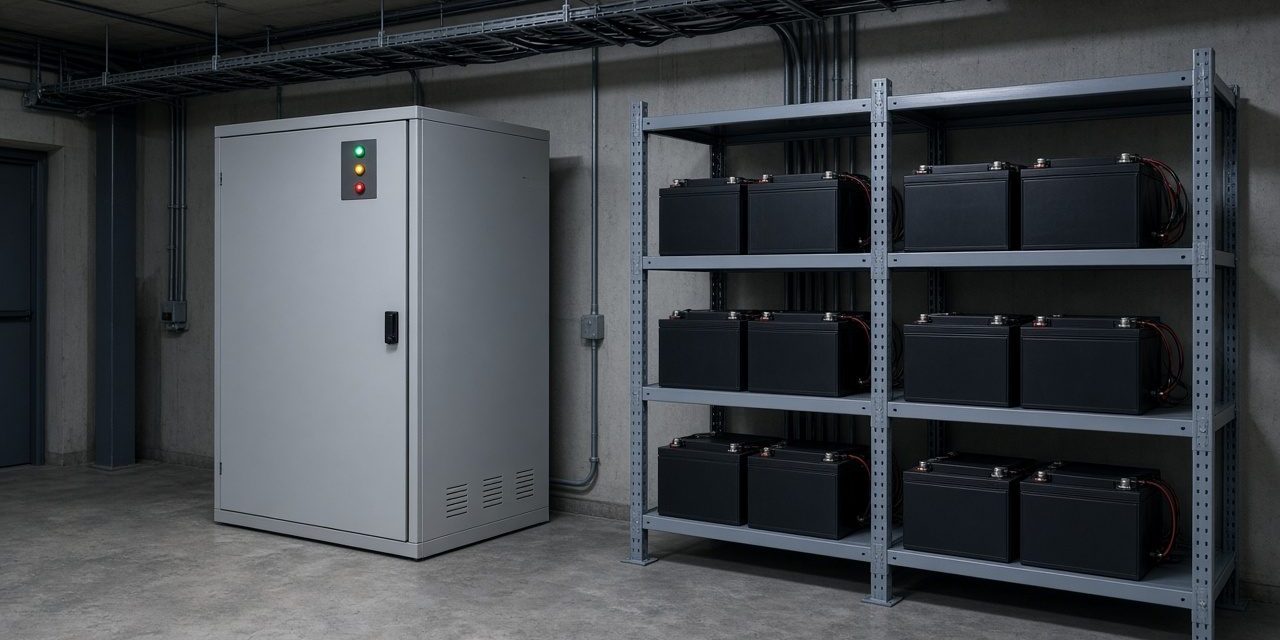
The UPS cabinet is the electronics. The batteries are the stored minutes. Sealed lead-acid blocks (VRLA) are the common choice in a plant room; they are sized as a string voltage the UPS expects, then as parallel strings when more time is required. Lithium blocks are used where weight, room, or cycle life rules out lead-acid. Either way, runtime falls as the batteries age, and a monitoring or scheduled test is what tells you the bank will still carry the load.
A parallel or redundant arrangement (two UPS modules sharing the load, so one can fail or be serviced) is for rooms where even maintenance must not stop the equipment. It does not replace a battery test.
UPS and generator, in that order
A generator takes tens of seconds to start and accept load. The UPS covers that gap, then the generator feeds the UPS input so the batteries can recharge. The UPS also isolates the load from the generator’s own voltage dip at the moment of transfer. Without the UPS, a generator still leaves a break. Without the generator, the UPS only lasts as long as its batteries.
Practical sizing and commissioning notes
- Measure the real load. Record watts, power factor, inrush, and the phase balance instead of adding nameplate values blindly. A UPS is sized by both kVA and kW, and the smaller limit wins.
- Leave engineering margin. A unit operating permanently at its limit has no useful room for a new server, a motor start, or battery ageing. The final margin belongs in the design calculation, not in a guess.
- Test the bypass and the battery path. Commissioning should prove normal mode, battery mode, static bypass, maintenance bypass, alarm contacts, and the planned shutdown sequence.
Keep the single-line diagram, battery string map, autonomy test result, and the date of the last capacity test beside the equipment. A UPS is not commissioned when its display says
Normal
; it is commissioned when the site has proved what happens during a real transfer and knows which alarm reaches which person.
Common problems and how to fix them
The UPS beeps and goes to battery while the lights are still on
The mains is present but outside the window the UPS will accept: voltage too low, too high, or the frequency is wandering. A stabilizer ahead of the UPS, or a wider input range on the next unit, stops the batteries being used as a daily regulator. Repeated short discharges wear a lead-acid bank out long before its years are up.
Runtime is far shorter than it used to be
- The load has grown. New equipment was plugged into the UPS circuit.
- One or more blocks in the string have failed and are pulling the rest down.
- The room is hot. Battery life drops sharply above a normal electrical-room temperature.
- The bank was never discharged under a real test, so the nameplate time was never the true time.
Servers reboot when the generator starts
The generator voltage or frequency stepped outside the UPS input window, so the UPS dropped the input and the batteries were already flat from the outage. Set the generator governor and the UPS input tolerance so the handover is accepted, and confirm the battery runtime covers the start delay with margin.
Frequently asked questions
Does a UPS replace a generator?
No. A UPS covers seconds to minutes and cleans the power. A generator covers hours. Sites that cannot stop use both.
Why not put the whole building on the UPS?
Air conditioning, heaters, and ordinary lighting are large loads that can tolerate a short break. Putting them on the UPS multiplies the battery bank and hides the loads that actually matter. Split the circuits.
How often should batteries be tested?
A scheduled discharge or impedance test, at least yearly, plus a check after any outage that ran the bank hard. Waiting for the next power cut is how sites discover a dead string.
Talk to PSS about backup power
PSS sizes, supplies, and maintains UPS and battery systems for the loads that cannot drop. Contact the PSS team to book a first site survey.
