


On this page
- 01Before you start
- 02Two pillars — and integration
- 03Paid parking components
- 04Operating models
- 05Tariffs, grace and revenue
- 06Lane throughput and presales
- 07Parking guidance architecture
- 08Indicators, displays, ZCU, software
- 09Find My Car
- 10Visitors, VIP, reserved, accessible
- 11Civil works and protection
- 12Inductive loops
- 13Guidance wiring and network
- 14Outdoor guidance
- 15Integration
- 16Reliability, safety, cyber
- 17Check that it works
- 18Common problems and how to fix them
- 19Frequently asked questions
- 20Talk to PSS about parking systems
Modern parking is no longer only concrete storage. Airports, malls, hospitals, HQ campuses, hotels, compounds and public facilities use parking technology to control access, collect fees, monitor occupancy, move traffic and improve the visitor journey.
A Parking Management System (PMS) coordinates identification, barriers, ticketing, payment, subscriptions, visitor rights and revenue reports. A Parking Guidance System (PGS) finds vacant bays and guides drivers to floors, zones and spaces. Success needs traffic capacity, equipment placement, civil works, power, network, ops procedures and expansion — not gadgets alone. The barrier is only the mechanical actor the driver sees; the system is a small data platform with a large physical footprint.
Before you start
- Entry/exit lanes and peak vehicles/hour (and peak 15 min)?
- Ticket, ANPR, RFID or hybrid — visitors/residents/staff mix?
- Pay-on-foot or pay-at-exit?
- Tariff scheme: hourly, flat, validation, season, free period, grace?
- Surface paved yet — where can loops be cut?
- Power and network at each island — who supplies?
- Zone counting or full bay guidance / Find My Car?
- Access, CCTV, BMS, payment integrations and protocols?
- Fire free-exit and power-failure behaviour?
- Intercom/help point ownership; outdoor vs indoor sensor mix?
Two pillars — and integration
PMS (paid / managed parking): sessions, tariffs, payment validation, exit authorization, audit trails. Typical kit: boom barriers, ticket dispensers, ANPR/LPR, RFID, APMs, entry/exit terminals, vehicle detectors, central software. Ticketless sites may drop dispensers; staff lots may use plates/RFID instead of visitor charging.
PGS (guidance): vacant/occupied detection via sensors or cameras; LED bay indicators, directional signs, floor/zone counts, reserved/accessible ID, Find My Car, utilization reports.
Integrated smart parking joins PMS + PGS + access + payment + monitoring — e.g. ANPR at entry, barriers, pay-on-foot, camera/ultrasonic guidance, staff subscriptions, VIP/accessible/EV bays and revenue. Design one coherent architecture, not isolated devices.
Paid parking components
Entry station: ticket/QR printer, RFID reader, intercom, presence interface, ANPR mount, driver display, lane controller/network. Presence → credential → session → barrier per sequence. Ticket may link to plate for lost-ticket recovery.
Boom barriers: cabinet, motor/drive, control, arm, base, detectors, access interfaces. Select for arm length/lane width, open/close time, duty cycle, durability, IP/environment, safety I/O, parking-controller integration, manual release, spares. High throughput needs frequent-duty hardware — never assume “100% duty” or “high speed” without datasheet. Breakaway arms limit some impact damage; they do not replace detection or safe lane design. Ticket/ANPR/payment/driver delay often limits throughput more than arm travel.
Illustrative ranges (verify OEM): short fast arms ~1.3–2.5 s (often ≤~3.7 m); commercial ~3–4 s; long/low-cost ~5–6 s. Faster is not always safer in mixed pedestrian lanes. Duty: rough bands ~50–300 cycles/day standard; ~300–1,000+ high-cycle; continuous for peak hold-open facilities — undersizing duty is a common early motor failure.
| # | Lane type | Boom (typical) | Open time (illustrative) | Duty tendency |
|---|---|---|---|---|
| 1 | Residential / low | 3–4 m | ~5–6 s | ~50–300 / day |
| 2 | Commercial entry | ~3.7–4.5 m | ~3–4 s | ~300–1,000 / day |
| 3 | Fast exit | up to ~3.7 m | ~1.3–2.5 s | High-cycle |
| 4 | Wide / service | 6 m+ | ~4–6 s | Standard + rest post |
Pay-on-foot APM: read credential → retrieve session → tariff → pay (cash/card/contactless/wallet as supported) → receipt → mark paid for exit. Place on pedestrian routes near lifts with queue space — poor placement creates congestion and complaints.
Exit station: detect → ticket/RFID/QR/ANPR → session → payment/exemption check → authorize → open → log exit → close session. Unreadable cases need defined help: cashier, intercom, operator plate search.
Operating models
| # | Model | How identified | Strength | Watch |
|---|---|---|---|---|
| 1 | Ticket / barcode / QR | Printed or app ticket | Familiar for visitors | Lost tickets, jams, pay-station queues |
| 2 | Ticketless ANPR/LPR | Plate at entry/exit | Fast, traceable, subscriptions | Not infallible — need fallback |
| 3 | RFID / subscription | Card/tag | Staff, residents, monthly | Schedules, expiry, cloning risk |
| 4 | Hybrid | Plate + credential | Mixed visitor/season traffic | Two integrations to maintain |
Ticket flow: entry session → pay-on-foot/cashier → exit validation. Define lost/damaged/duplicate/dispute procedures.
ANPR: plate creates session; exit retrieves and checks payment. Benefits: less paper, faster lookup, registered vehicles, access/security links. Performance depends on camera position, lighting, plate condition, speed, format and software — manufacturer % claims are test-condition specific. Realistic well-installed lanes often land ~95–98% correct reads across conditions; 99%+ mainly in controlled, well-lit, low-speed lanes. Separate read rate from accuracy. Design for the 2–5% that fail: help button, intercom, manual override. Mount angle, IR and height matter — too high or much beyond ~30° to the plate hurts night reads.
RFID: monthly/annual, staff/tenant, visitor/contractor, reserved, schedules, expiry, history; may pair with ANPR to flag tag/vehicle mismatch.
QR / mobile: reservations, digital permits, online pay, renewals, invitations, extensions, receipts — define expiry, reuse, offline behaviour, unreadable phones.
Tariffs, grace and revenue
Models: fixed duration, hourly/partial-hour, progressive, daily max, overnight, weekend/event, free initial period, vouchers, subscriptions, reserved/premium.
Illustrative calc: first 30 min free; each started hour after = 10; daily max 80. Enter 10:00, exit 12:20 → after free period, 1 h 50 min → two started hours → 20 (if no other rules). Test partial hours, grace, caps, overnight and overlapping tariffs — logic differs by platform.
Grace after payment: e.g. 15–20 min illustrative walk-back time — set from APM-to-bay distance, floors, lifts, internal congestion, exit distance and policy. Define start, expiry and congested-exit behaviour.
Reports / audit: lane revenue, duration/occupancy, discounts, lost tickets, subscriptions, unpaid sessions, manual opens, APM faults, operator/config changes — role-based permissions for disputes and reconciliation.
Lane throughput and presales
Excellent kit still fails if lanes are short for the arrival pattern.
Peak demand: study busiest hour and busiest ~15 minutes, queue length, transaction time, stacking space. Example: 3,000 vehicles in one pre-event hour → 50/min average — that is a traffic/queue study, not a barrier catalogue pick.
Preliminary lane count:
N = ⌈ λ / (μ × U) ⌉
where λ = design vehicles/hour, μ = validated capacity/lane, U = planning utilization less than 1. Example: 600 / (300 × 0.70) → ⌈2.86⌉ = 3 lanes — not final queue design; validate μ; model spillback, outages, lane split.
What sets real capacity: barrier cycle; ANPR/auth; ticket/RFID/QR time; driver reaction; detection/safety; geometry; lane payment; anti-tailgate; peaks; faults. Ticket + pay-at-exit often ~250–350 veh/h in good conditions; free-flow ANPR subscription lanes can exceed ~600 while rolling — do not use one generic VPH for every site. If peak exceeds ~300/h per lane, add a lane before stacking software features. Add exit redundancy — exits decide reputation.
Queue layout: stacking length, vehicle length/spacing, merge/diverge, pedestrians, emergency access, spillback onto public roads, entry/exit separation, pull-aside for assisted vehicles.
Parking guidance architecture
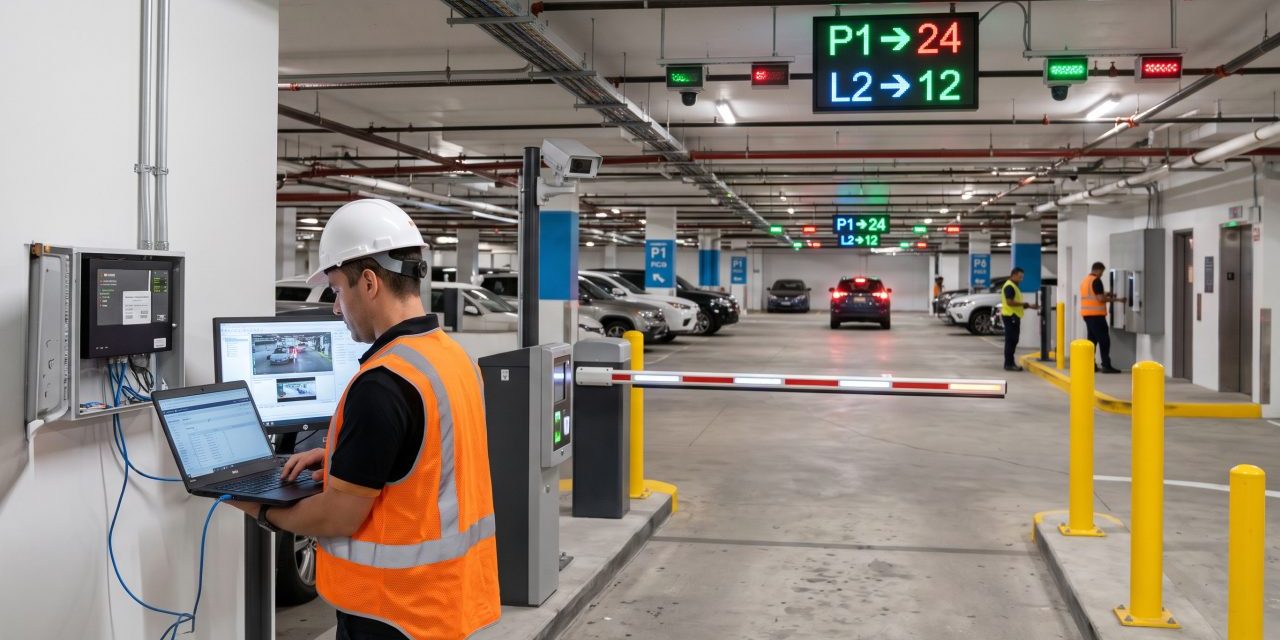
Sensors/cameras → zone controllers → network → LED indicators + directional signs → central software.
Facility / zone / bay levels stack: entrance totals → floor/zone counts → bay LEDs. Example: see floors available → follow arrow → green bay light.
Ultrasonic: overhead in covered garages; pulse return → occupied/vacant; often with LED; tune for height, angle, vehicle size, obstructions. One bay per sensor typical.
Camera guidance: multi-bay analytics (some products up to ~six bays — varies by FOV/layout); may add ANPR, Find My Car, duration stats, evidence. Needs light, mount, clear view. Occupancy camera ≠ reliable LPR unless specified.
Outdoor: magnetic in-ground, wireless, outdoor cameras, radar, zone counting at portals — not indoor ultrasonics under open sky. Plan battery/radio life, pavement, weather, surge, IP/temp.
Above roughly ~300 bays, bay-level guidance often pays back in reduced search traffic; zone counting alone can drift until signs say “full” over empty rows.
Indicators, displays, ZCU, software
Bay LEDs (common scheme — document consistently): green available; red occupied; blue accessible/other category; yellow/purple reserved/VIP/pre-book. Indicators inform — they do not enforce; need ANPR/policy/ops for that.
Directional displays: spaces by floor/zone, arrows, full/closed, reserved notes. Define behaviour on sensor/comms failure.
Zone Control Units: sensor count limits, cable length/type/topology, power, addressing, fault detect, software compatibility — large sites need many ZCUs.
Central software: live occupancy, floor/zone availability, device faults, utilization/turnover, history, reserved monitoring, PMS/access links. Distinguish occupied vs reserved-unavailable vs unknown.
Find My Car
Large malls/airports: search by plate/QR/kiosk after camera-based bay association (e.g. “B2 / Zone C / C-142”). Ultrasonic-only systems know vacant/occupied but not which vehicle. ANPR location needs privacy and retention policy.
Visitors, VIP, reserved, accessible
Visitor: host registers plate/period → temp auth → ANPR/RFID/QR/operator → barrier → directed area → expiry. Visitor-mgmt integration reduces re-keying.
VIP: whitelist ANPR (no standard ticket if rules allow); optional reserved zone/LED, reception notify, log.
Reserved / accessible / EV / staff / tenant / fleet: vacant ≠ available to all. Accessible bays need dimensions, routes, signage and enforcement per applicable rules.
Civil works and protection
Design before paving. Loops saw-cut before final asphalt/interlock; conduits and pull pits cast early. Sequence: traffic study → lane/island layout → loops → containment → barriers/devices → software → real-vehicle commissioning. After paving, every loop becomes a peeling retrofit.
Islands: height/dimensions (often ~150–200 mm as a concept — not universal), driver reach to ticket/pay, approach geometry, arm clearance, drainage, conduits, maintenance, markings.
Bollards: location/spacing, impact class, foundations, clearance to terminals, pedestrian visibility — protect without blocking reach or egress.
Shop drawings: full lane, clearances, cable routes, loop geometry, civil ↔ low-current interfaces, earthing, power/network at each island.
Inductive loops
Insulated wire in pavement + detector: vehicle metal changes inductance → presence.
Presence / request: require vehicle before ticket/entry — reduces wasted tickets; does not stop all fraud alone.
Safety: inhibit lower / protect while vehicle under boom — follow OEM geometry and site safety assessment. Loops alone ≠ full protection; often add photocells, safety edges, radar. Anti-crush chain: loop + photocells + radar + barrier reverse — a single sensor is a design flaw.
Install: shape/dimensions/turns, rebar clearance, feeder twist, water seal, tuning with real vehicles — exact values from detector/barrier docs. Typical field rectangle often ~1.8 × 0.9 m as a starting illustration. Frequency separation when loops are close. Barrier on a slope → boom never level / double detect.
Guidance wiring and network
RS-485 daisy-chain: device count, length, cable, termination, addressing, isolation, fault isolation — topology is OEM-specific.
Ethernet / PoE: only if device supports power budget; plan switch/PoE capacity, bandwidth, VLAN, distance, resilience, IP plan, cybersecurity. Many sites mix Ethernet + RS-485.
Trays: coordinate lighting/HVAC/fire/signs; support, labels, power/signal separation, bend radius, no sag over indicators/cameras.
Outdoor guidance
Magnetic, outdoor wireless, elevated cameras, radar, portal zone counting + outdoor LED signs. Solar or mains displays as site allows. IP, temperature, mount, surge.
Integration
CCTV/VMS: dispute video, unauthorized access, entry/exit evidence, barrier incidents, location support — confirm APIs.
Access / visitor: shared users/schedules — door ACS does not replace tariffs/ticketing/session logic.
BMS: occupancy/alarms/selected lighting — never replace approved life-safety ventilation/smoke logic.
Payment/accounting: gateways, IDs, secure refunds, reconcile failed txs; card data per payment architecture and rules.
Fire: barriers must free-exit on fire alarm (typically dry contact from fire panel) — life safety, not a convenience.
Reliability, safety, cyber
Document power-loss and server-down behaviour, local operation, manual release, emergency access, vehicles already inside, transaction recovery, operator actions. Revenue may need to block unauthorized entry while still providing safe exit — no single formula for every site. UPS on exit lanes: a blip with boom down queues onto the street.
Cyber/privacy: strong auth, RBAC, secure remote, segmentation, patching, backups, time sync, override audit logs, controlled retention of plates/images.
Check that it works
- Detection, ticket issue/validate, timestamps, tariffs/grace and payment methods verified under load.
- Subscriptions/visitors, ANPR exceptions, safety response and manual/emergency opens demonstrated.
- PGS sensor↔bay map, LED colours, floor/zone counts and directional signs match known occupancy.
- CCTV/access/BMS/payment links, fire free-exit and power-loss behaviour commissioned.
- Drawings, device lists, configs, test results, training and maintenance docs handed over.
Common problems and how to fix them
Barriers without a traffic study
Kit fails when lanes are short for the arrival pattern. Size from peak hour and peak 15 minutes, not brochure open time.
One generic VPH for every site
Ticket + pay-at-exit often ~250–350 veh/h; free-flow ANPR can exceed ~600. Validate μ per operating model before locking lane count.
ANPR treated as infallible
Design for the 2–5% that fail: help button, intercom, manual override. Separate read rate from accuracy.
Wrong sensor tech outdoors
Indoor ultrasonics under open sky drift and fail. Use outdoor-rated magnetic, wireless, camera or radar products.
Reserved-space logic ignored
Vacant ≠ available to all. Configure VIP/accessible/EV/staff categories in software and enforcement.
Bad APM placement
Machines far from lifts create queues and complaints. Place on pedestrian routes with stacking space.
Loops after paving or through rebar
Saw-cut and seal before final surface; follow OEM geometry and clearance. After paving every loop is a retrofit.
Undersized buses, PoE, network
Plan switch/PoE capacity, VLANs and device counts. Mixed RS-485 + Ethernet is common — size both.
No island or bollard protection
Protect terminals without blocking driver reach or egress. Freeze shop drawings before pour.
No manual, fire free-exit or privacy plan
Document lost-ticket, power-loss, free-exit on fire alarm and plate/image retention before handover.
Frequently asked questions
PMS vs PGS?
Sessions/money/access vs vacancy guidance — they can share one platform.
What if a ticket is lost?
Operator plate search if ANPR recorded; else lost-ticket policy/fee.
Can ANPR replace tickets?
Yes in designed ticketless sites — keep fallback for many facilities.
How accurate is ANPR?
Site/product/conditions — set an acceptance test; well-installed lanes often land ~95–98%.
How many spaces per guidance camera?
Model/FOV/height — use OEM coverage drawings.
Does outdoor PGS work?
Yes with outdoor-rated sensors, cameras or radar — not indoor ultrasonics.
Can VIP/visitor bays be reserved?
Yes if software supports categories/permits and ops enforce them.
What is a grace period?
Time after payment to exit without extra charge — set from walk-back distance and policy.
Why use inductive loops?
Presence and barrier safety — follow OEM geometry; combine with photocells/radar.
What does Find My Car need?
Bay association (usually camera/ANPR) — ultrasonics alone cannot identify the car.
What if the server fails?
Architecture-dependent — define local fallback and reconciliation before purchase.
Talk to PSS about parking systems
PSS designs, installs, and maintains access control parking and barrier systems — PMS, PGS, ANPR and lane equipment — sized from peak traffic and civil constraints. Contact the PSS team to book a first site survey.